
The urban environment of Ottawa, ON, presents one of the most challenging landscapes for textile maintenance in North America due to its extreme sub-arctic winter cycles. As temperatures frequently plummet below -20C, municipal and residential maintenance protocols necessitate the heavy application of chemical de-icers. These substances, while essential for pedestrian safety in areas like Kanata, Nepean, and Orléans, are mechanically transported into the home via footwear, where they settle deep within carpet piles.
The geographic reality of the National Capital Region means that carpets are not merely aesthetic choices; they are functional thermal insulators. However, during the transition from winter to spring, these fibers become saturated with a complex matrix of road salt, sand, and organic slush. This saturation point turns the carpet from a protective filter into a source of secondary indoor pollution.
Understanding the environmental load of an Ottawa household requires a conceptualization of the “Environmental Wheelbarrow” theory. Every resident inadvertently loads their indoor space with pollutants, and the capacity of the home to manage this load depends on the efficacy of the “emptying” process—professional cleaning. Without intervention, the buildup of these materials leads to a catastrophic degradation of both the flooring and the air quality.
Chemical Mechanisms of Road Salt and De-icers on Textile Fibers
The primary chemical threat to Ottawa carpets is the diversity of de-icing agents used on the streets of Stittsville and Barrhaven. Sodium Chloride (Rock Salt) is the most common, appearing as large halite crystals that leave a white, powdery residue. These residues are inherently alkaline, often reaching a pH level between 8 and 10, which can chemically “burn” natural fibers like wool and destabilize dyes in synthetic nylon.
Calcium Chloride (CaCl2), the “blue salt” used for extreme cold, is significantly more destructive due to its hygroscopic properties. It actively pulls moisture from the Ottawa air, ensuring that entryways remain perpetually damp even in a heated room. This moisture retention creates a breeding ground for bacteria and leaves an oily, greasy film that traditional vacuuming cannot remove.
The interaction between these salts and the carpet backing is often exothermic, releasing heat as the salts dissolve in tracked-in snow. This heat can accelerate the bonding of oils and tannins to the fiber, making a simple salt stain a permanent fixture if not neutralized. Furthermore, the corrosive nature of chloride ions weakens the latex adhesives used in carpet construction, leading to delamination and structural failure.
Table 1: Chemical Profiles and Material Impact of Ottawa Winter Contaminants
The Physics of Mechanical Degradation: Sand, Grit, and Friction
In addition to chemical threats, the physical impact of sand and grit is a primary cause of carpet aging in Ottawa. To provide traction on icy sidewalks, municipal crews often distribute millions of tons of inorganic grit. These particles are jagged and microscopic, allowing them to penetrate the carpet surface and settle against the primary backing.
As occupants walk across the carpet, the pressure of a human step (approx. 20-30 psi) grinds these particles against the base of the fibers. This creates a “sandpaper effect” that physically cuts the yarn over time, a process known as mechanical shredding. Once this structural damage occurs, the carpet loses its luster and density, appearing “worn out” even if it is technically clean.
Effective maintenance in the National Capital Region must therefore prioritize high-airflow dry soil removal. Standard upright vacuums often fail to reach the depth required to extract these abrasive minerals. Only professional-grade equipment, following the IICRC S100 principles, can effectively dislodge these particles before they cause irreversible damage to the investment.
Microbiological Proliferation in the Post-Winter Environment
As Ottawa transitions into the spring thaw, the slush and moisture trapped in carpets begin to undergo biological transformations. Mold spores, which are naturally present in the environment, find an ideal habitat in the damp, dark recesses of carpet padding. If the relative humidity (RH) inside the home exceeds 50%, these spores can colonize organic materials within 24 to 48 hours.
Dust mites are a secondary biological threat that thrives in the moisture provided by melted snow. These microscopic arachnids do not bite, but their fecal matter contains proteins that are potent allergens for asthma sufferers. In the tightly sealed homes of Kanata and Nepean, these allergens accumulate to concentrations that can be ten times higher than outdoor levels.
The science of bio-contaminant reduction relies on two factors: sanitization and rapid drying. Traditional cleaning methods that leave carpets wet for days essentially provide a “spa” for microbial growth. Modern protocols must ensure that the floor returns to a dry state within 1 to 4 hours to interrupt the life cycle of mold and mites.
The “Filter Effect” and VOC Dynamics
A foundational principle of modern environmental science is that carpet acts as a giant air filter. By trapping airborne particulates, it prevents them from circulating in the breathing zone. However, like any filter, it has a finite capacity. When a carpet is saturated with Ottawa road salt and winter dust, it begins to release these particles back into the air with every footstep.
Furthermore, carpets are known as “sinks” for Volatile Organic Compounds (VOCs) and Semi-Volatile Organic Compounds (SVOCs). Chemicals from cleaning products, paints, and outdoor smog are adsorbed by the fibers and then slowly re-emitted over years. This “sink effect” can lead to chronic exposure to low levels of benzene or other toxins, which is particularly dangerous for infants and elderly residents.
To maintain a healthy home, the EPA and Health Canada recommend a strategy of “Source Control”—removing the pollutants at their origin. This requires professional deep extraction that doesn’t just clean the surface but flushes the entire fiber system. In the National Capital Region, where seasonal spikes in allergies are common, this maintenance is a critical health intervention.
The Chemistry of Suspension: pH Balancing for Salt Removal
Effective carpet cleaning is an exercise in applied chemistry, specifically regarding the pH scale. Most indoor soils are acidic (oils, food, skin cells) and are best removed with alkaline cleaners. However, the salts and ice-melts used in Ottawa are already highly alkaline. Applying a traditional high-pH cleaner to these areas is ineffective and can cause the salt to bond more tightly to the fiber.
The IICRC S100 standard dictates that for salt removal, a professional must use an acidic rinse to neutralize the alkaline crystals. This chemical neutralization converts the salt into a soluble state that can be easily extracted. Hot Carbonating Extraction (HCE) provides an inherent advantage here, as carbonated water is naturally slightly acidic (H2CO3), providing the necessary neutralization without the use of harsh synthetic acids.
Choosing the wrong pH level can be catastrophic for the carpet’s longevity. For instance, wool fibers can suffer chemical burns if exposed to a pH above 8.5, while some synthetic dyes will “bleed” if the pH is too low. Professional technicians in Kanata are trained to test the fiber and the stain before selecting the appropriate chemical countermeasure.
Traditional Steam Cleaning vs. Carbonation
The choice of cleaning methodology in Ottawa often comes down to the battle between high-moisture and low-moisture systems. Traditional Steam Cleaning (Hot Water Extraction) involves pumping large volumes of soapy water into the carpet at pressures up to 600 PSI. While this can flush out surface dirt, it often drives water and silt deep into the backing and subfloor.
The primary failure of the steam method in the National Capital Region is the drying time. In a humid Ottawa spring, these carpets can stay wet for 24 to 48 hours, creating an unacceptable risk for mold. Furthermore, the soapy detergents used in these machines are difficult to rinse completely. The remaining residue acts like a dirt magnet, causing the carpet to re-soil rapidly and look dingy within weeks of cleaning.
Hot Carbonating Extraction (HCE) represents a technological evolution. By utilizing millions of microscopic, carbonating bubbles, the process achieves soil suspension with 80% less water. These bubbles “explode” the dirt off the fiber and lift it to the surface, where it is whisked away by high-suction equipment. This allows for a 1-2 hour drying time and a residue-free finish that keeps carpets cleaner for much longer.
Table 2: Comparative Performance Metrics for Urban Floor Care
Molecular Propellants
The efficacy of the carbonation method is rooted in molecular physics. In traditional cleaning, water serves as the only medium for transport. In the HCE process, the carbonated bubbles act as miniature propellants. This is identical to the reaction of club soda on a wine stain; the fizzy action literally lifts the pigment out of the textile weave.
This lifting action is critical for Ottawa carpets that are packed with dense silt and road salt. High-pressure water can actually force these contaminants deeper into the carpet base. Carbonation, however, works from the bottom up, ensuring that the soil is moved toward the extraction head rather than away from it.
Because the bubbles provide the mechanical energy needed to break surface tension, there is no need for the harsh surfactants found in typical soaps. Surfactants are designed to bridge the gap between oil and water, but they are notoriously difficult to extract. By removing them from the equation, the carbonation process protects the indoor air quality from chemical off-gassing and ensures the fibers remain soft and resilient.
Solving the “Reappearing Stain” Phenomenon
Many Ottawa homeowners are frustrated by stains that seem to return a few days after cleaning. This is not a failure of the homeowner; it is a result of “Wicking”. When the carpet backing and pad are saturated with water, any remaining soil in the base dissolves into a liquid slurry.
As the surface fibers dry, they act like a wick in a candle, drawing the liquid up through capillary action. When the water evaporates at the tip of the fiber, it leaves the dirt behind, recreating the stain. This is particularly common with pet urine and spilled coffee, which often penetrate into the padding.
The HCE process as practiced in Kanata eliminates this issue by keeping the backing dry. Because the moisture is concentrated only on the fiber itself, there is no reservoir of liquid in the padding to facilitate wicking. This ensures that once a stain is extracted, it stays gone, providing the long-term aesthetic results that Ottawa residents demand.
HEPA Filtration and the Removal of Ultra-Fine Particulates
For residents in the National Capital Region with severe respiratory issues, the removal of ultra-fine particulates is a medical necessity. Standard vacuum bags often act as “dust pumps,” trapping large grit but allowing the most dangerous, microscopic allergens to pass through and be aerosolized.
The HEPA (High-Efficiency Particulate Air) standard requires that a filter must trap 99.97% of particles as small as 0.3 microns. To put this in perspective, a human hair is roughly 75 microns wide; bacteria are about 0.3 to 60 microns, and viruses are as small as 0.004 microns.
By using professional extraction systems equipped with HEPA-level filtration, a cleaning service can effectively remove mold spores (1-30 microns) and dust mite body parts (100-300 microns) that are embedded in the carpet. This is why the Quebec Asthmatic Association specifically recommends the Chem-Dry method; it is one of the few systems that addresses the microscopic triggers of asthma.
Source Control and Seasonal Maintenance Cycles in Ottawa
The EPA and local government boards advocate for a “Source Control” approach to indoor health. In Ottawa, this means interrupting the seasonal transport of pollutants before they can be permanently ground into the floors. A typical residential maintenance cycle should be anchored in the local climate patterns.
-
October (Pre-Winter Prep): Application of a fiber protectant to prevent road salt from chemically bonding to the yarn.
-
January (Mid-Winter Refresh): Interim cleaning of high-traffic entryways to remove the heavy accumulation of Calcium Chloride and slush.
-
April (Post-Winter Restoration): A deep, professional carbonated clean to flush out the winter’s “environmental wheelbarrow” and prepare for the spring allergy season.
This proactive approach significantly extends the life of the carpet. Studies show that a well-maintained carpet can last twice as long as one exposed to seasonal neglect, saving homeowners thousands of dollars in replacement costs. In a region with high real estate values like Kanata and Stittsville, floor maintenance is a critical component of property preservation.
Chem-Dry Imperial and the Ottawa Protocol
Chem-Dry Imperial, headquartered in Kanata, ON, has established the benchmark for high-performance floor care in the National Capital Region since its inception in 1993. Owned by Chris McWhinnie, the firm has dedicated over 30 years to perfecting a process that addresses the specific chemical and biological challenges of the Ottawa climate.
Proprietary Technology and “The Natural®” Solution
The core of the Chem-Dry Imperial difference is “The Natural®”, a proprietary cleaning solution that has earned the Carpet and Rug Institute (CRI) Platinum Seal of Approval. Unlike the harsh detergents used by many Ottawa “steam” cleaners, The Natural® is a soap-free, Green-Certified agent composed of ingredients whose equivalents are found in nature.
This solution is engineered to work in tandem with the Hot Carbonating Extraction (HCE) equipment. When heated and pressurized, millions of tiny bubbles in The Natural® penetrate deep into the base of the carpet. This chemical “explosion” dislodges the Sodium Chloride and oily residues that are characteristic of Ottawa’s winter streets.
Because the process uses approximately 80% less moisture than traditional methods, the carpets in a typical Ottawa home will be dry in just one to two hours. This rapid drying is essential for the region’s health standards, as it prevents the proliferation of mold and mildew in the humid spring months.
Specialized Service Lines for the National Capital Region
Chem-Dry Imperial offers a comprehensive suite of “Healthy Home Services” designed for both residential and high-traffic commercial environments in Stittsville, Nepean, and Orléans. These services are informed by the highest industry certifications, including IICRC-trained technicians and endorsements from the Quebec Asthmatic Association.
-
P.U.R.T.® (Pet Urine Removal Treatment): A specialized chemical reaction that doesn’t just mask pet odors but contacts and destroys the underlying urea crystals.
-
Area Rug Restoration: Expert care for fine rugs, which act as “silent partners” in trapping allergens in Ottawa living rooms.
-
Upholstery & Leather Care: Using the HCE process as a “high-performance filter” to deep-clean furniture, which absorbs skin cells and pollutants over time.
-
Commercial Floor Maintenance: Custom-designed programs for Ottawa offices that manage heavy winter foot traffic and salt buildup in lobbies and corridors.
The Three Risk-Free Guarantees
Chris McWhinnie and his team at Chem-Dry Imperial operate under a transparent, customer-first model that eliminates the “sales gimmicks” common in the industry. They provide exact, on-site pricing before any work begins, charging by the square foot rather than using hidden fees. Their commitment to the Kanata community is backed by three distinct guarantees :
-
The “Cleanest, Fluffiest, Healthiest” Guarantee: If you are not satisfied with the results, the cleaning is free.
-
The 30-Day Warranty: If a stain reappears after the technician is gone, they will return to remove it at no charge.
-
The Spot Removal Guarantee: If they cannot remove a stain that another company can, they will pay for the other company to do it.
This level of accountability has made them the most trusted name in Ottawa carpet cleaning for over a generation.
Technical FAQ: Complex Challenges in Ottawa Carpet Care
1. How does the “sink effect” impact my home’s air quality during an Ottawa winter? The “sink effect” refers to the carpet’s ability to adsorb Volatile Organic Compounds (VOCs) and then slowly re-emit them. During winter, when Ottawa homes are tightly sealed to conserve heat, VOCs from household products can reach high concentrations. Professional HCE cleaning flushes these compounds out of the fiber matrix, reducing long-term exposure.
2. Why is Calcium Chloride (the blue salt) so much harder to clean than white Rock Salt? Calcium Chloride is highly hygroscopic, meaning it constantly attracts moisture from the air. This creates an “oily” feel that traditional soap-based cleaners struggle to break down. The carbonated bubbles in the Chem-Dry process are physically small enough to penetrate this oily film and lift it off the fiber.
3. What is the molecular difference between wicking and a new stain? Wicking is a subsurface phenomenon where soil from the carpet backing travels up to the surface via capillary action during drying. A new stain occurs on the surface. If a spot returns after a traditional steam cleaning, it is almost certainly wicking caused by over-wetting the carpet pad.
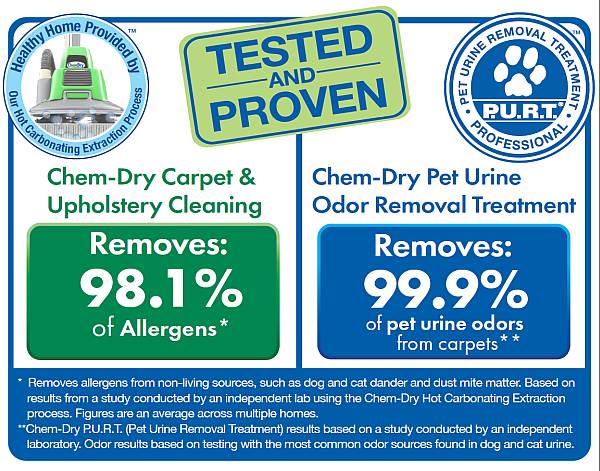
4. How does the Quebec Asthmatic Association determine its recommendations? They look for systems that demonstrate deep soil extraction, resistance to bacterial proliferation, and an absence of irritating chemical residues or strong perfumes. The Chem-Dry system’s Green-Certified solution and 98% allergen removal rate satisfy these rigorous health criteria.
5. Can the exothermic reaction of ice-melt chemicals melt my carpet fibers? While rare, the heat released by dissolving Calcium Chloride, combined with friction from heavy boots, can reach temperatures that soften synthetic fibers like polyester. This often manifests as “fusing” or permanent matting in entryways. Protecting these areas with rugs or runners is essential.
6. Does the age of an Ottawa home affect its indoor air pollution levels? Older homes in the National Capital Region may have less efficient mechanical ventilation but more natural air exchange. New homes are very “tight,” meaning pollutants like CO2 and radon can accumulate faster. In both cases, the carpet acts as the primary particulate sink that requires semi-annual emptying.
7. Why do detergents in DIY machines make carpets get dirty faster? DIY detergents are often highly concentrated surfactants that are impossible to rinse out with home-grade machines. These residues are chemically designed to attract dirt. Once the carpet dries, the residue stays on the fiber and “grabs” the next piece of dust or salt that comes into the house.
8. What is the difference between a MERV 13 filter and a True HEPA filter? A MERV 13 filter captures about 75-85% of particles in the 0.3-1.0 micron range and is common in HVAC systems. A True HEPA filter must capture 99.97% of particles at the 0.3-micron level. For those with allergies, only HEPA-level filtration in a vacuum can effectively remove settled dust mite allergens.
9. How does pH neutralization work for pet urine in Ottawa basements? Pet urine starts as an acidic solution but becomes highly alkaline as it dries and turns into salt crystals. These crystals are hygroscopic and smell worse on humid days. The P.U.R.T.® process uses a chemical reaction to dissolve these alkaline crystals, removing the odor at the molecular level rather than just covering it up.
10. Why is the “Most Penetrating Particle Size” (MPPS) 0.3 microns? Particles at 0.3 microns are too small to be trapped by simple inertial impaction but are too large to be efficiently captured by random Brownian diffusion. This “middle ground” makes them the hardest to catch, which is why the HEPA standard specifically targets this size.
Authoritative Resources and Health Guidelines
-
Environmental Protection Agency (EPA): National standards for indoor air quality and source control. https://www.epa.gov/indoor-air-quality-iaq
-
Health Canada: Residential guidelines for carbon dioxide, radon, and VOCs in Canadian homes. https://www.canada.ca/en/health-canada/services/publications/healthy-living/residential-indoor-air-quality-guidelines-carbon-dioxide.html
-
IICRC (Institute of Inspection Cleaning and Restoration Certification): Technical cleaning protocols and ethical standards. https://iicrc.org/iicrccertifications/
-
Asthma Canada: Strategies for reducing indoor triggers and improving respiratory health. https://asthma.ca/get-help/asthma-triggers/indoor-triggers/
-
Ottawa Public Health: Local health alerts and environmental safety guidelines for residents of the National Capital Region. https://www.ottawapublichealth.ca/en/public-health-topics/radon-in-your-home.aspx
Conclusion:
The technical audit of the Ottawa indoor environment reveals that floor maintenance is not merely a matter of aesthetics but a fundamental component of public health. The “environmental wheelbarrow” of a typical house in Kanata or Nepean is subject to extreme seasonal loading of toxic chlorides, abrasive silica, and biological allergens.
Traditional methods that rely on high-moisture saturation are increasingly viewed as obsolete in sub-arctic climates due to their inability to prevent wicking and mold growth. The scientific evidence strongly favors low-moisture, carbonated extraction systems like those utilized by Chem-Dry Imperial. By providing a residue-free clean that neutralizes alkaline salts and removes 98% of allergens, the HCE method represents the current “Gold Standard” for the industry.
For the residents of the National Capital Region, the path forward involves a shift toward professional, certified maintenance cycles. By integrating high-airflow HEPA vacuuming with periodic carbonated deep cleaning, homeowners can protect their structural investments while ensuring the highest possible indoor air quality for their families. In the challenging climate of Ottawa, science remains the most effective tool for maintaining a healthy and vibrant home.